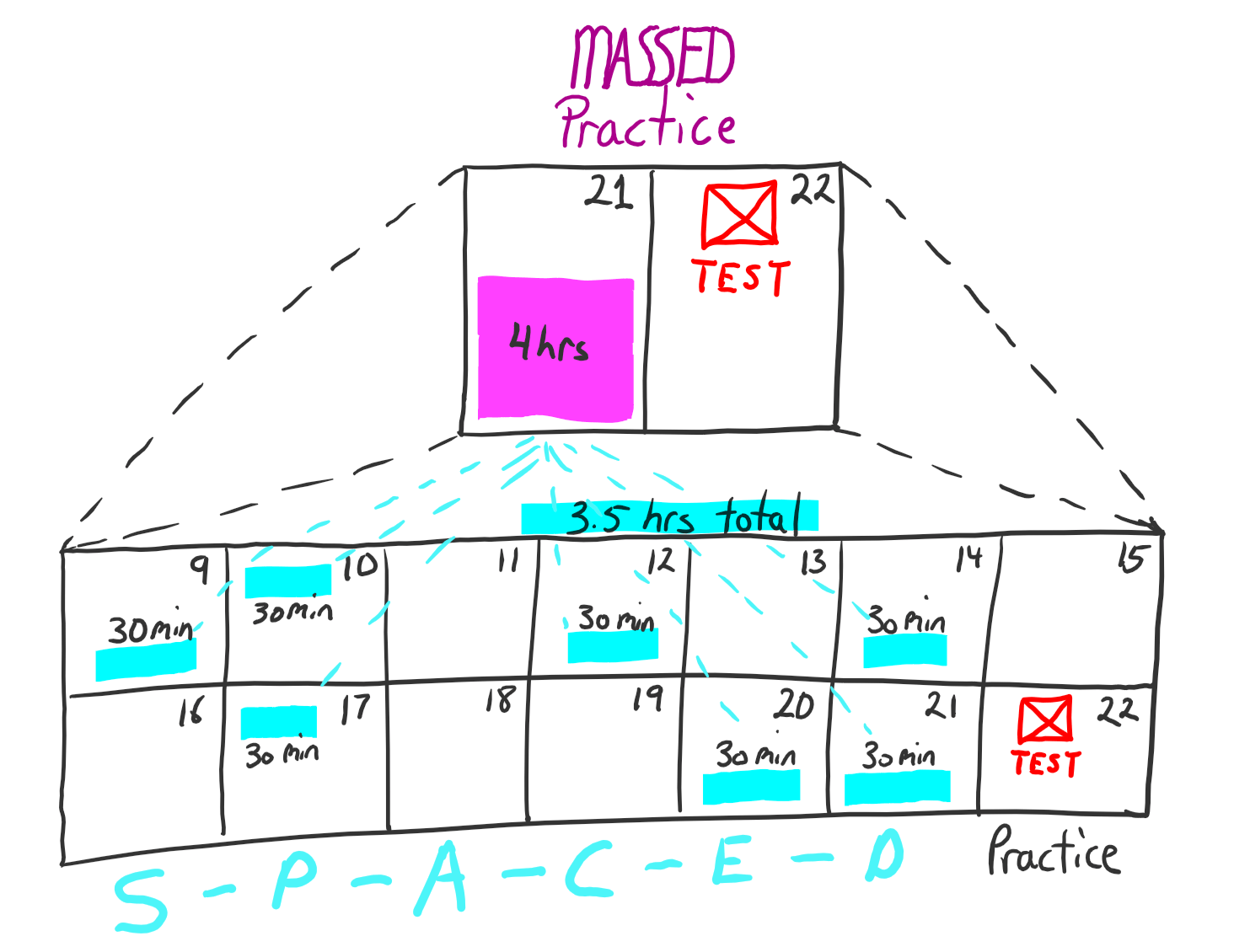
The Cognitive Science of Studying: Massed Practice vs. Spaced Practice

Very nice article! I’m going to repost in on our blog.

Jesseb Adam's avatarInstructional Design: Engagement Activities and Strategies

I’ll just come out and say it: students don’t know how to study.

When students are asked how they study the response is often something along these lines:

  • Wait until the night before the test
  • Find my notes and textbook
  • Read/reread notes and textbook
  • Highlight stuff
  • Repeat until I can’t stay awake any longer or distraction gets the best of me

There are several problems with this approach. In an earlier post I covered Rereading vs. Retrieval Practice, and what current research says about these two approaches.

This article compares:

2. Massed Practice vs. Spaced Practicemassed practice purple

Whether it’s studying for an American History test or practicing hitting curve balls, massed practice can be described as a single, long “study session” going over the same information or skill. Most of us know it as cramming. It is usually easy to see improvement from the beginning of a massed practice session…

View original post 643 more words

5 E’s!

priscillaparton's avatarPriscilla's World of Science

5/26/15

The 5 E’s is an instructional model based on the constructive pathway to learning, which says that learners build or construct new ideas on top of their old ideas.  The 5 E’s can be used with students of all ages, including adults.  Each of the 5 E’s describes a phase of learning, and each phase begins with the letter “E”: Engage, Explore, Explain, Elaborate, and Evaluate.  The 5 E’s allows students and teachers to experience common activities, to use and build on prior knowledge and experience, to construct meaning, and to continually assess their understanding of a concept.

Engage: This phase of the 5 E’s starts the process. An “engage” activity should do the following:

  1. Make connections between past and present learning experiences
  2. Anticipate activities and focus students’ thinking on the learning outcomes of current activities. Students should become mentally engaged in the concept, process, or skill to be learned.

View original post 155 more words